
When you think about a roof, what’s the first thing that comes to mind?
For most people, it’s just the shingles. But what people don’t realize is that there’s a whole lot more to a roof than just shingles. That’s right: shingles are just a part of a much larger system.
At Topper Roofing, we work with homeowners across Frederick and throughout Maryland who are often surprised to learn their roof is a full system, not just a single layer.
In fact, what really matters when it comes to a long-lasting roof system isn’t even what you can see. Here’s what really goes into a durable, long-lasting roof, and why it matters more than you might think.
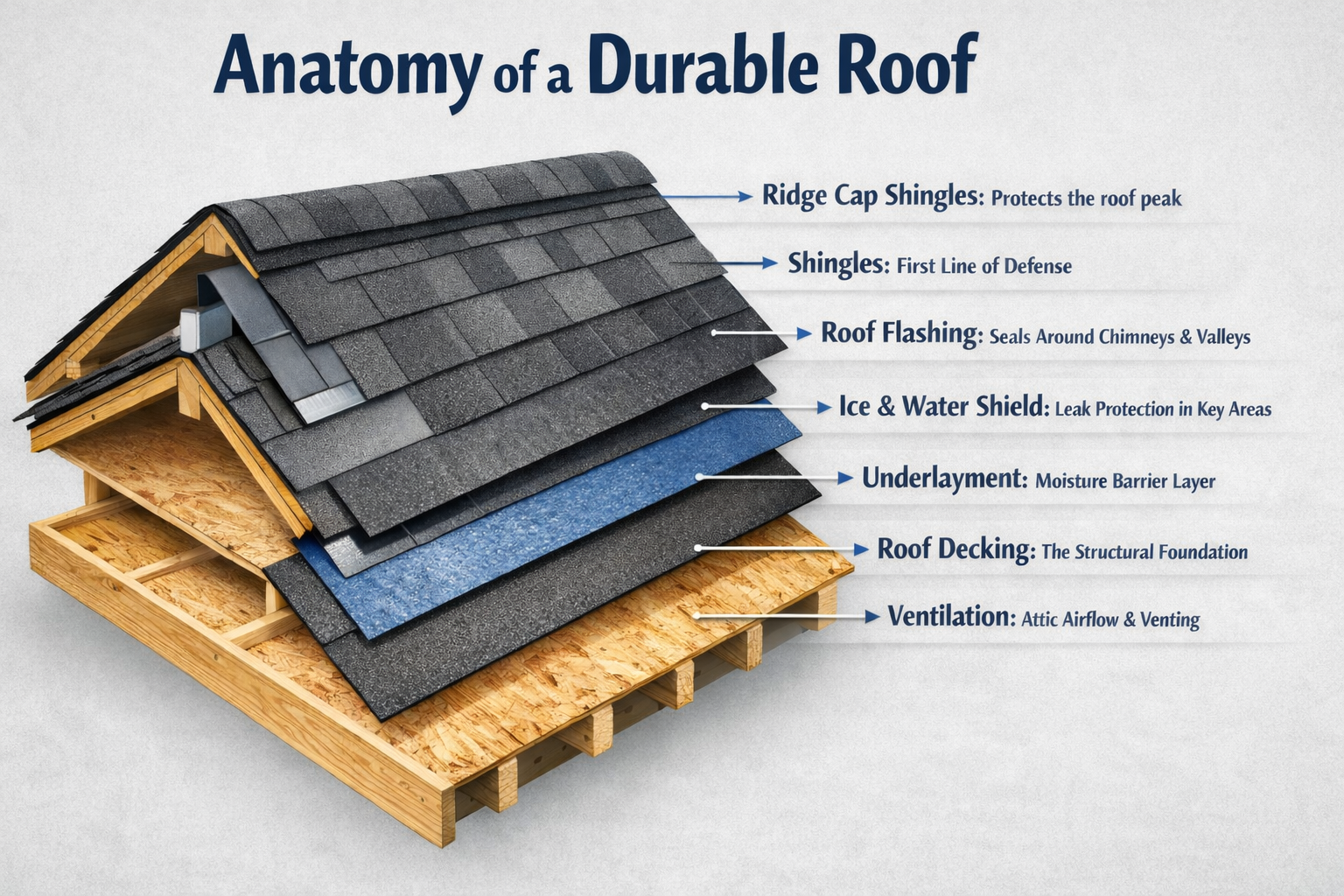
It Starts with the Decking: The Foundation You Don’t See
At the heart of every roof is the roof decking, usually made of plywood or OSB.
If the decking has been compromised due to moisture damage or age, new shingles will not correct the problem; they will mask it. Therefore, during our roof replacement service, we always make it a point to check and replace decking that has been compromised.
As your local roofing contractor, we have seen many problems begin here, out of sight, and yet already impacting the performance of your roof.
Underlayment: Your Backup Protection
Installed directly over the decking, the underlayment acts as a secondary barrier against water.
Shingles are meant to keep water out, not seal it out completely. There may be times when heavy rains and strong winds bring moisture into your home from underneath the shingles. This layer prevents moisture from entering your home.
Synthetic underlayment is stronger than felt and can withstand temperature changes and severe weather in many regions.
Ice & Water Shield: Extra Protection Where It Counts
Some areas of your roof deal with more water than others, like valleys, edges, and around penetrations.
That’s where ice and water protection comes in. This self-adhering layer is installed in leak-prone areas to provide a tighter seal and help prevent water intrusion, especially during freeze-thaw cycles.
It’s one of the most effective ways to prevent hidden water leaks from occurring in the future.
Flashing: Sealing the Vulnerable Areas
Any area where your roof meets your wall, chimney, or an opening requires additional sealing.
Roof flashing is installed in these areas to help guide water away and prevent it from penetrating your home. This includes step flashing along walls, valley flashing where roof slopes meet, and pipe boots that seal around plumbing vents.
In our experience, flashing issues are one of the most common causes of roof leaks and one of the most overlooked during poor installations.
The Details That Protect the Edges
Some of the most important parts of a roof are not always in full view.
Drip edge is installed around the edges of a roof to direct water to the gutters and keep it from getting underneath other roofing materials.
Without this, water can seep slowly into the edges of the decking.
Starter shingles are installed beneath the first row of shingles to seal them in securely and help fight against wind uplift.
At the very top of a roof, ridge cap shingles cover the entire top, protecting one of the most exposed parts of a roof while also providing ventilation.
While they might seem minor, they make a big impact on a roof’s performance over time.
Ventilation: What Happens in Your Attic Matters
Your roofing system is not just about keeping rain out; it’s also about having adequate roof ventilation.
This refers to having a balance of intake and exhaust vents. These are usually placed at the soffits and the ridges, respectively. The combination of both enables air to flow through your attic to help control temperature and moisture levels.
If there’s inadequate ventilation, your roof may experience:
- Reduced lifespan of the shingles
- Warped decking
- Moisture problems or mold
We’ve seen how poor ventilation can quietly shorten the life of an otherwise well-built roof.
Shingles: The First Line of Defense
Shingles are the outermost part of your roofing system and your first line of defense against the elements.
Shingles are meant to withstand water, wind, and sun, but they are dependent on all the parts below them to work effectively.
Good shingles are not going to last long if the system below them was not installed correctly.
Why the System Matters More Than Any Single Part
It’s easy to think of roofing as a simple replacement, old shingles off, new shingles on.
But a professional roofing system consists of multiple layers. Each part plays an important role in working in conjunction with the others. If one part is missing or incorrectly installed, it could impact the life expectancy of the entire roof.
That’s the difference between a long-lasting roof and one that requires costly early repairs.
What This Means for Your Home
If you are considering a roof repair or replacement, there are a number of things you might want to consider.
Take a step back and ask what’s really going on beneath the surface. Ask how each step of the process is being addressed.
At Topper Roofing, we are committed to building a roof, not just laying shingles on a roof.
This is because we know that a roof that is well-built doesn’t just look nice when it’s finished; it also works as well as it’s supposed to. If you have questions about your roof, we are here to help.
Contact us today for a free inspection and practical guidance.