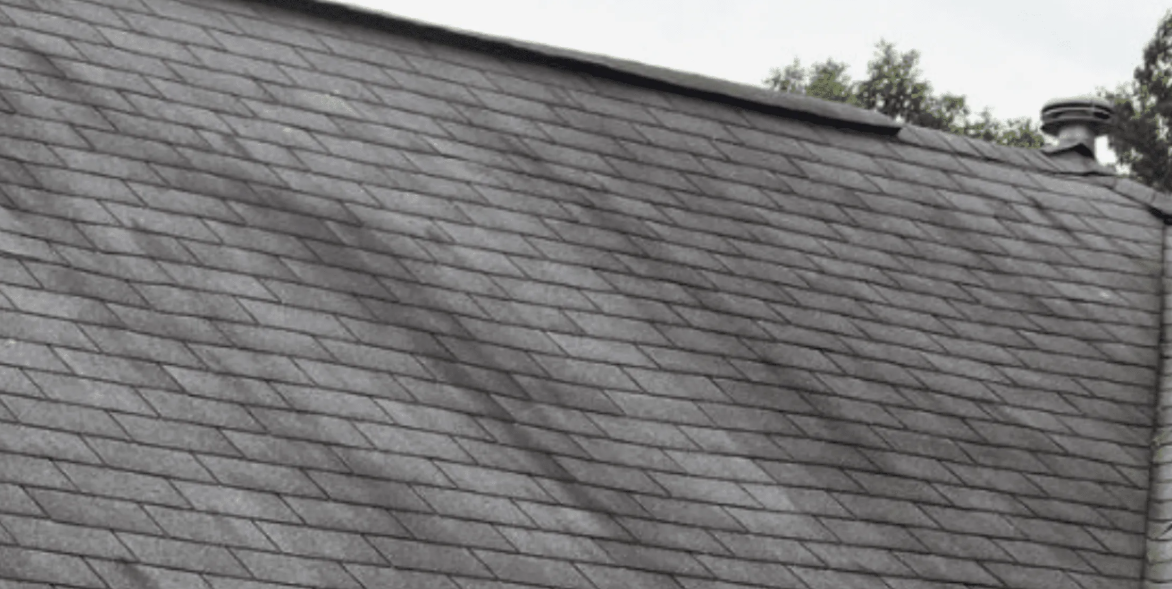
Take a walk around your neighborhood this time of year, and you’ll probably spot it: a roof with dark streaks running down from the ridge, usually on the side that gets the least sun. Most homeowners assume it’s dirt, soot, or age catching up with the shingles. But at Topper Roofing, we see these streaks often enough to know there’s usually something else going on. Once you understand what’s actually causing them, the right way to deal with them makes a lot more sense.
It’s Not Dirt. It’s Not Even Technically Algae.
The dark stains referred to as “roof algae” are often caused by an organism known as Gloeocapsa magma. Contrary to popular belief, this is not a plant algae at all; it’s actually a species of cyanobacteria, commonly referred to as blue-green algae. This has been a problem seen for decades in America, but there is no need to learn the science behind this topic; just one piece of information: this particular organism can survive in limestone.
Asphalt shingles use limestone in their manufacturing process. Since the limestone in the shingles acts as a food source for this organism, it can flourish within this material, forming dark coatings to protect itself from sunlight as its colonies grow. It is these coatings that appear as dark stains on your driveway.
Why Summer Is Prime Time for This
Humid and warm weather is precisely what the organism requires. Spores spread across rooftops through the wind and settle where it’s warm and moist. This is why they can be found mostly on north-facing slopes and roofs under tree shade. Moisture remains in these places longer compared to others and dries slowly, providing spores with enough time to become settled.
Summer humidity simply provides it with perfect conditions for growth.
Cosmetic Problem or Real Damage? A Bit of Both.
In the initial phases, algae staining is largely a cosmetic problem. There will be no immediate threat to your roof, and it does not mean that you should immediately start panicking at the first signs of algae on your roof.
The algae themselves may pose little threat, but the additional moisture they create will make it easier for moss and lichen to grow, and these will pose a much more serious threat. That is why this problem is not an immediate danger, but it is still not a problem to neglect, especially in the future.
Treatment vs. Cleaning: Why the Difference Matters
This is where a lot of well-meaning homeowners go wrong, so it’s worth spelling out clearly.
Cleaning means the physical removal of what is visible through such methods as rinsing, scrubbing, or pressure washing of the surface. There will be a temporary improvement, and the streaks will disappear from the roof. However, unless the problem of growth is treated, cleaning will only involve getting rid of the visual part of the problem.
Treatment means applying a solution that kills the growth rather than simply removing what’s visible on the surface. This is the approach the roofing industry itself points to for dealing with algae discoloration on asphalt shingles, and it’s a low-pressure process, not brute force.
Why does it matter? Because when you apply inappropriate treatment for algae discoloration on your roof, you are likely to get the wrong results. High pressure is often thought to be the right way to treat the problem, yet asphalt shingles are not designed to withstand high pressure. They get stripped of the protective granules, and those granules never grow back. This is an easy way to worsen the problem instead of solving it.
What We’d Actually Recommend
If you’re seeing streaking and want it handled the right way:
- Skip the pressure washer. High pressure can strip away the protective granules on asphalt shingles.
- Treat, don’t just clean. A proper low-pressure treatment addresses the growth instead of simply removing what’s visible.
- Don’t wait until it spreads. Addressing algae early can help keep a cosmetic issue from becoming a larger maintenance concern.
- Get a second opinion if you’re not sure what you’re looking at. Algae streaking, moss, and lichen all show up differently and call for different approaches. Treating one like another can waste time and money.
Don’t Let Summer Streaks Become a Bigger Problem
While black streaks might just be an aesthetic concern in the beginning, it is an issue that should be inspected anyway. The longer the algae growth goes on, the more difficult it will be to fix, and using the wrong method to clean it could actually cause damage to your roof.
Dark streaks forming on your roof this summer? At Topper Roofing, we can take a look at those dark streaks and help you determine what’s growing on your roof and whether it needs treatment or further attention.
Contact us to get a closer look before a simple maintenance issue becomes a bigger roofing headache.